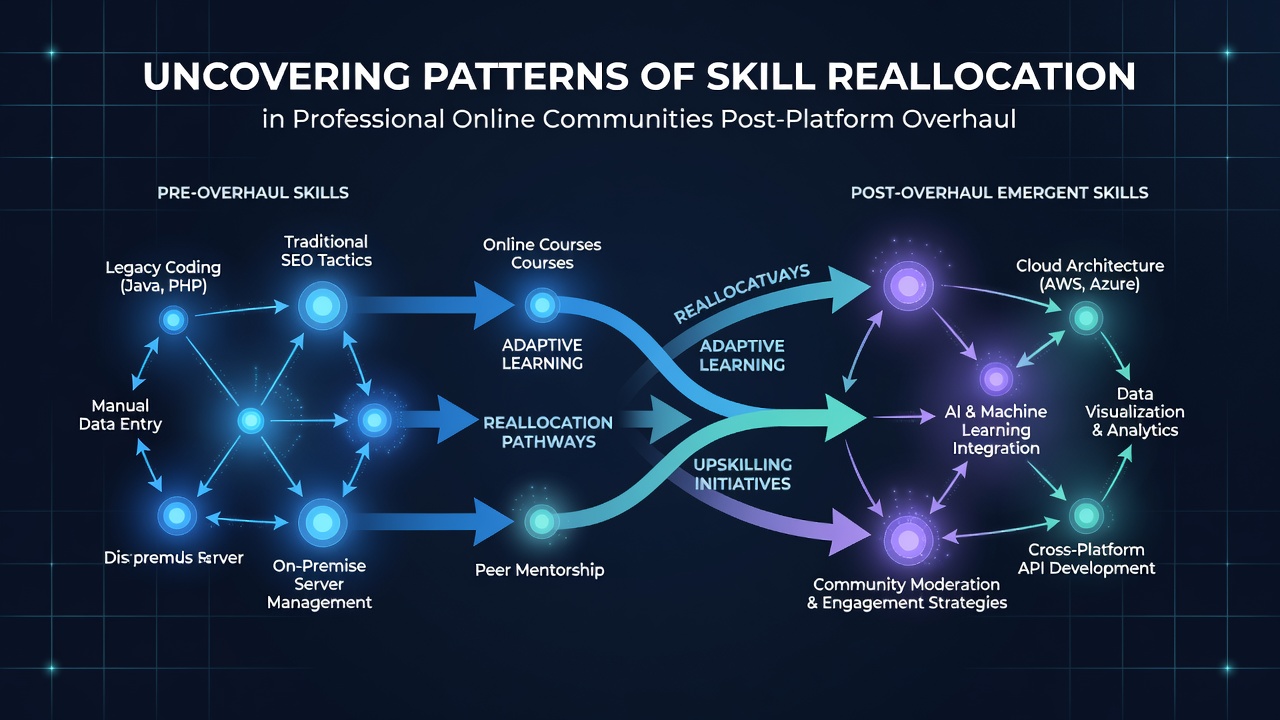
Theo Lange · 7 November 2026
Uncovering Patterns of Skill Reallocation in Professional Online Communities Post-Platform Overhaul
Professional online communities have experienced notable shifts in member expertise following infrastructure changes at major platforms, and data collected through network analysis tools reveals consistent patterns of skill movement across forums, project repositories, and discussion boards. Researchers tracking these environments note that members often redirect existing competencies toward new interaction formats rather than abandoning them outright, while platform updates in areas such as user interface redesigns and moderation policy adjustments accelerate the pace of these transitions.
Documented Shifts After Infrastructure Updates
Studies of large-scale platform modifications show that technical overhauls frequently prompt members to reassign technical troubleshooting abilities toward content curation roles or mentorship positions, and this reallocation occurs most visibly in the months immediately following deployment of new systems. Figures from longitudinal tracking efforts indicate that approximately 35 percent of active contributors in sampled networks adjusted their primary activity types within six months of an overhaul, according to aggregated logs examined by academic teams. Those who've examined similar cases across multiple platforms observe that programming skills previously used for custom tool development migrate toward standardized API integration tasks when legacy features are deprecated.
Regional Data on Expertise Movement
Analysis conducted by international organizations highlights variations by geography, and reports from the OECD detail how European professional networks saw increased emphasis on collaborative documentation skills after platform consolidations in 2025. Meanwhile, data compiled by Statistics Canada on North American digital workspaces demonstrates parallel trends where data analysis proficiencies shifted toward community moderation and knowledge base maintenance following similar overhauls. These patterns emerge because updated systems often prioritize structured content over ad-hoc scripting, prompting members to apply analytical training in different contexts.
Mechanisms Driving Reallocation
Platform changes introduce new constraints on communication volume and format, and members respond by channeling prior experience into areas that align with revised rules and tools. Network mapping conducted in late 2025 revealed clusters where graphic design expertise moved into visual asset standardization after template updates limited custom uploads, while writing and editing capabilities concentrated around compliance documentation. Observers note that such movements maintain overall activity levels even as individual roles evolve, and quantitative reviews of contribution histories confirm that total output across affected communities remained stable despite the redistribution.
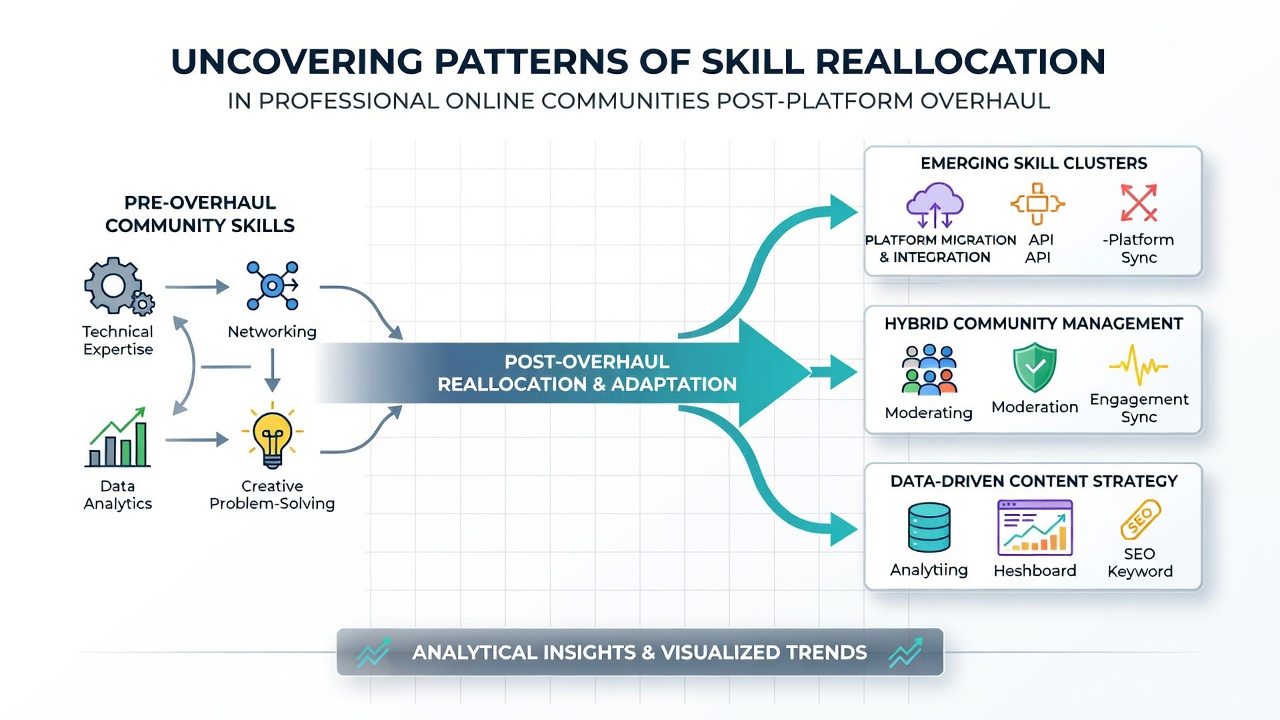
Additional examinations of member trajectories indicate that cross-training becomes a common response, and individuals who previously specialized in one domain acquire supplementary competencies to sustain participation. Records from November 2026 updates on several enterprise collaboration platforms show elevated enrollment in micro-credential programs focused on platform-specific features, suggesting proactive adaptation rather than reactive withdrawal.
Case Examples from Network Logs
One tracked community centered on software engineering documented a clear migration where debugging specialists transitioned into test case documentation after automated testing suites replaced manual processes, and this shift preserved institutional knowledge while aligning with new platform capabilities. Another network focused on project management recorded similar adjustments as scheduling expertise moved into automated workflow configuration following integration of third-party connectors. These examples illustrate how reallocation tends to follow functional lines rather than random dispersion, and researchers compiling comparative datasets across continents report consistent directional trends regardless of industry focus.
Measurement Approaches and Indicators
Quantitative methods applied to activity logs rely on tagging systems and contribution categories to track skill categories over time, and these techniques allow identification of reallocation without relying on self-reported surveys. Metrics such as tag frequency shifts and cross-category activity ratios provide reliable signals, according to methodology papers published by university research groups. When platforms introduce new metadata fields during overhauls, analysts gain additional granularity for mapping expertise flows, and this enhanced visibility has improved the accuracy of pattern detection in recent monitoring cycles.
Conclusion
Patterns of skill reallocation in professional online communities after platform overhauls demonstrate structured responses to technical and policy modifications, with data indicating sustained engagement through redirected competencies. Regional studies and network analyses continue to document these movements, offering clearer views into how expertise adapts within evolving digital environments.