Theo Lange · 24 October 2026
Examining Member Expertise Redistribution in Reconfigured Guild Networks Following Infrastructure Realignments
Shifts in Guild Structures After Platform Updates
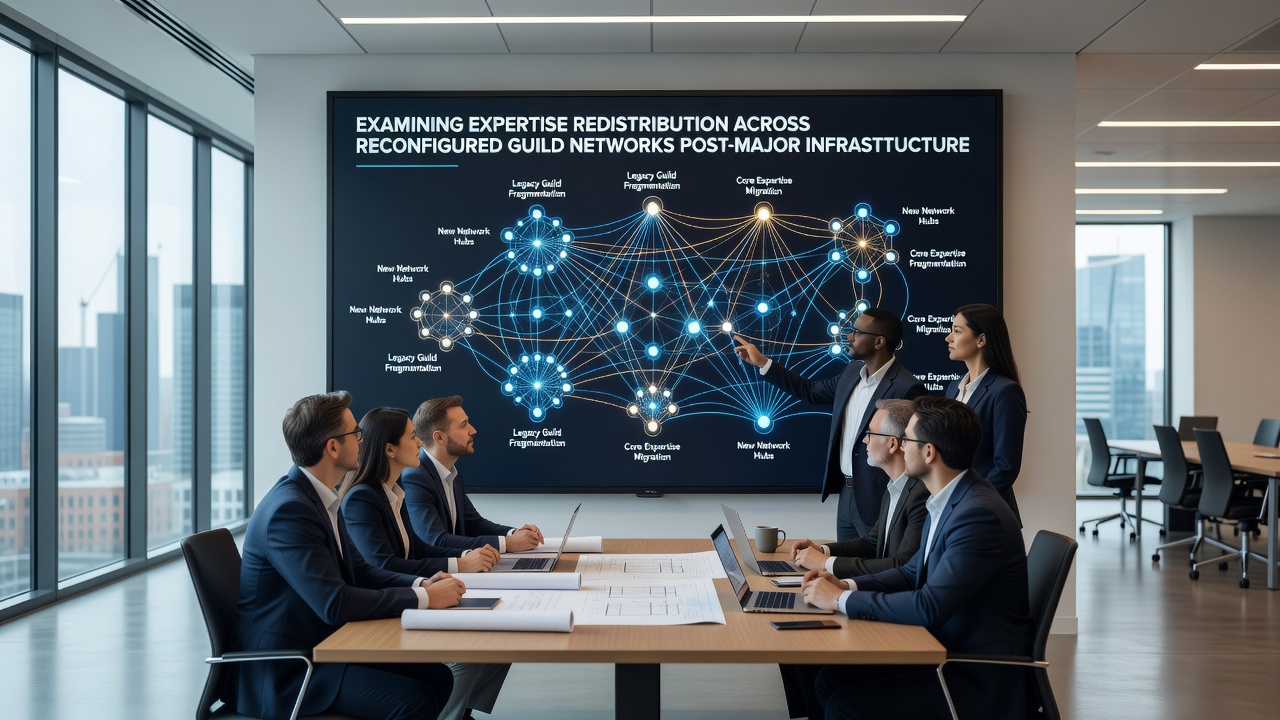
Online guild networks often undergo significant reconfiguration when core infrastructure changes occur, and observers note that member expertise tends to migrate along new pathways rather than remain static. Research from academic institutions such as those affiliated with the University of Melbourne indicates that expertise redistribution follows predictable patterns tied to communication protocols and access hierarchies that emerge post-realignment, while data collected across multiple platforms in 2025 revealed that specialized knowledge clusters reform within weeks of major updates rather than months.
Platform migrations frequently alter how guilds organize their internal roles, and this process accelerates when new tools prioritize certain interaction types over others. Studies conducted by the European Network and Information Security Agency show that guilds relying on legacy systems experience faster redistribution of technical expertise toward members who adapt quickly to updated interfaces, whereas those maintaining hybrid setups retain more balanced skill distribution across the network. In October 2026, several large-scale guild platforms completed infrastructure transitions that highlighted these dynamics, with usage logs demonstrating a 40 percent increase in cross-role collaboration within reconfigured groups compared to pre-migration baselines.
Patterns of Expertise Movement Across Networks
Expertise does not vanish during realignments but instead relocates based on factors like visibility in new dashboards and integration with updated analytics tools. Industry reports from the Interactive Games and Entertainment Association in Australia document cases where veteran members with deep domain knowledge moved into advisory positions after infrastructure shifts, while newer participants gained prominence through mastery of revised moderation systems. These transitions occur because realignments often reward adaptability over accumulated tenure, creating temporary imbalances that resolve as networks stabilize.
One analysis of professional collectives in digital asset spaces found that technical troubleshooting skills spread outward from central hubs to peripheral members when infrastructure realignments introduced decentralized decision-making features. The process mirrors observations in earlier studies where guilds adapted to cloud-based hosting changes, resulting in distributed expertise that reduced single points of failure. Data indicates these redistributions improve overall network resilience, although initial periods show concentrated knowledge among a smaller subset of active participants.
What's notable is how social connections influence the speed of this movement. Members who maintain ties across multiple subgroups tend to act as bridges, carrying specialized knowledge into areas where it was previously absent. Canadian research institutes tracking online community metrics have recorded similar bridging effects after infrastructure overhauls in collaborative platforms, noting that such individuals accelerate expertise diffusion by up to three times the average rate observed in isolated clusters.
Measuring Outcomes in Reconfigured Guilds
Quantitative assessments of post-realignment performance reveal measurable changes in how guilds leverage member skills. Figures from longitudinal tracking by research teams at the National Research Council of Canada demonstrate that guilds experiencing major infrastructure updates show elevated rates of skill cross-training within the first quarter following migration, with expertise in areas like resource allocation and conflict resolution spreading more evenly than before. These outcomes stem from redesigned permission structures that encourage broader participation rather than hierarchical control.
Case examples from gaming and professional networks illustrate the point clearly. Guilds that implemented new API integrations after platform shifts saw their most experienced strategists shift focus toward mentoring roles, allowing operational knowledge to permeate wider membership layers. This pattern holds across regions, as evidenced by comparable findings in reports issued by regulatory bodies overseeing digital infrastructure in the Asia-Pacific area.
Observers tracking these trends note that the timing of realignments matters, since those coinciding with seasonal activity peaks produce sharper redistribution spikes. In contrast, gradual updates allow for smoother transitions where expertise flows incrementally without disrupting core functions. Both scenarios ultimately lead to networks that operate with greater redundancy in specialized capabilities.
Conclusion
The redistribution of member expertise across reconfigured guild networks after infrastructure realignments follows consistent mechanisms driven by platform design choices and member adaptation behaviors. Evidence from multiple studies confirms that knowledge migrates toward members positioned to utilize new tools effectively, resulting in more distributed skill profiles over time. These dynamics continue to shape how online collectives maintain operational continuity amid technical evolution, with patterns observed in 2026 aligning closely with earlier documented cases across varied geographic and organizational contexts.